
Our home

We have a hybrid heating system comprising of a heat battery, infra-red panels (which are great at keeping a person warm rather than heating the whole room), and more recently an air to air heat pump, often referred to as air conditioning.
We also have 18kWh home battery storage and two EVs, which between them cover around 25,000 miles a year the majority of which is charged at home using off peak, cheap electricity.
Our air conditioning
This is our ‘air conditioning unit’- technically an air-to-air heat pump. We fitted it primarily for the summer cooling but, having done that, we realised it was also an incredibly effective and efficient way to heat the lounge too. Units can look far more modern these days compared to the off-white plastic units you may have seen in offices and shops.


A heat battery
Our home also has a heat battery which is branded as a ZEB – Zero Emission Boiler. Slightly larger than a washing machine it is an easy to instal replacement for a gas boiler. This isn’t our ZEB because ours is in our garage as that is where the gas boiler was, and to prevent thermal losses into the garage the unit is housed in a thermally insulated box that doesn’t make for a great photograph!
Our solar panels
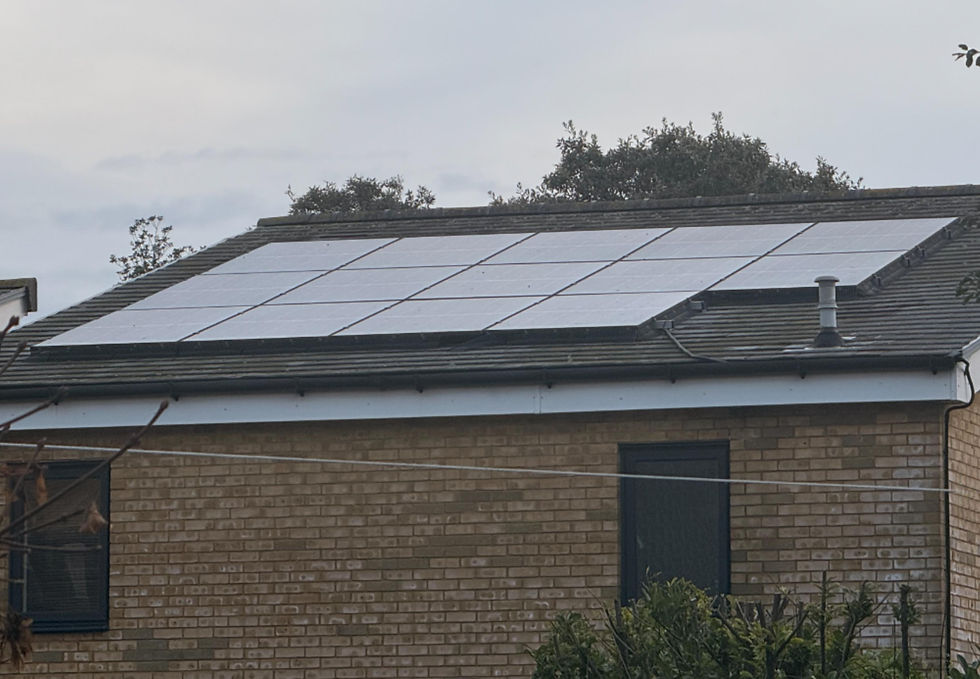
We have two arrays on our roof – long story – which comprises of 14 x 435W panels making a total array size of 6.1kw. In 2025 we generated 5.6kWh electricity, consuming around 90% and exporting the balance.

Air tightness test
We conducted an air tightness test where a large fan is attached to the front door opening and blows air into the house at a high pressure. It’s then a simple enough job to walk around the house and listen to hear where the air is escaping! This process has been mandatory for all new builds in England and Wales since June 2022. We determined our house is typical for a 2008 build and identified several areas to improve. However, care must be taken because air flow through a house is important as it helps prevent mould, so stopping every draft would be a bad idea.
Using infrared cameras to track down cold spots
An infrared camera allows you to easily see where cold is getting in, or where heat is getting out.
This is a small window in a downstairs toilet. The room has a radiator and as such is never cold, which gives the impression it’s thermally efficient.
What we didn’t realise was that the trickle vent behind the blind at the top of the window didn’t close properly, and because it was hidden from view it wasn’t immediately obvious. The dark spot on the camera drew our attention to it. An easy fix of some tape to keep the vent closed sorted the problem in the short term, before we replaced the vent.


Finding a leaky roof vent
During the air tightness test, you can hear the air escaping but it’s not always immediate obvious what’s happening. A smoke gun allows you to see exactly where a leak is. This is our glass roof with automated roof vents that open when the temperature inside exceeds a set level. This image is smoke from the gun rising up towards to roof.
As you will see, this video shows the smoke escaping and rising up into the air, making the leak crystal clear. We sent the video to the roof installer who fixed the problem under warranty. We’d never have known it didn’t seal very tightly without the air tightness test because it didn’t leak water and you’d never know there was a small draft under normal conditions.
Data from a typical winters day
Christmas day 2025 was cold in Kent – around zero overnight and just a few degrees above during the day.
This chart shows when we used grid electricity during the 24 hours of Christmas day. The left shows significant grid use during the night as we charged the electric and heat batteries, heated the hot water tank and ran the heat pump to prevent the house cooling too much overnight. We also topped up one of the cars overnight too. The grid draw stops at 5:30am which is the end of our off-peak, cheap electricity.
We used the energy stored to heat and run the house until the battery was exhausted around 8pm. There are a few small spikes of grid draw during the day which is when we were consuming more than our battery can provide at any one time – such as boiling the kettle whilst the heat pump was working hard.
We consumed 92.5kWh of which 91% (84kWh) was off peak. The total cost was £8.25, of which £1 was charging the car meaning running the house cost just over £7 for the day. The average unit price was just over 9p per kWh.
Breaking it down further, we added around 80kWh heat to the house (remembering that a heat pump outputs more heat than the electricity consumed). If that had been provided by a gas boiler running at 90% efficiency with gas at around 6.5p/kwh including VAT, the cost of gas would have been around £6. On top of that, cooking and lighting and powering the TV and X-Box would have been required of course.
By way of a conclusion, on a fairly cold day, our fully electric home with a hybrid heating system had running costs broadly similar to a gas boiler. If the temperature drops further, the cost will be marginally higher than gas but on milder day, the costs are lower. The key is to avoid using expensive peak rate electricity…


My three kids and I live in an old semi-detached property with poor insulation. Budgets are very tight, and I’ve been ripped off by builders in the past. I had no idea that there were grants available and, with Dave’s help, I’m pursuing the Warm Homes grant. It would make such a difference to us if we could get some loft insulation, improve the oldest windows and maybe even get some solar panels like our neighbours have as I know this will reduce my bills. I like that Dave explains things in a way I can understand.
Nicky | Kent
Dave and his family live a few doors down from us. They’ve had EVs for several years and when we decided to get our first EV, our usual electrician didn’t seem all that confident about installing a charger due to where our consumer unit is. I talked to Dave who had faced the same challenge a few years ago, and he recommended his installer who were great, helped by already knowing how to run the cable through the ceiling void. Sometimes it’s who you know that matters!
Ken | Kent
Dave and I connected on social media through our shared interest in electric heating — we both use the Tepeo ZEB, a heat battery that mimics the behaviour of a gas boiler. He’s clearly passionate about the green energy transition and genuinely enjoys helping others in our community of ZEB owners. He’s also always learning — recently diving into Home Assistant, which is a powerful tool for anyone wanting to monitor and optimise their home’s energy use.
Tim | Reading